Defying Gravity: The Fascinating Science Behind How Airplanes Fly
Do you know how a plane beats gravity? The secret isn't just the engines, but the wing shape and a 'tug-of-war' between 4 forces.
BLOGRECENTES
12/28/20255 min read
Whenever we look up at the sky and see a machine weighing tens, or even hundreds, of tons crossing the clouds, the same question arises: how is this possible? It seems like magic that something so heavy can defy gravity with such grace. However, flight isn't magic; it is a magnificent application of the laws of physics.
To understand how an airplane flies, we need to set aside the idea that it simply "floats" and start thinking of flight as a constant, dynamic battle. It is a perpetual tug-of-war between invisible forces acting on the aircraft every second it is in the air. The secret of flight lies in mastering and balancing these forces.
This article will demystify the process, breaking down the essential components that allow humanity to conquer the skies.
The Great Tug-of-War: The Four Forces of Flight
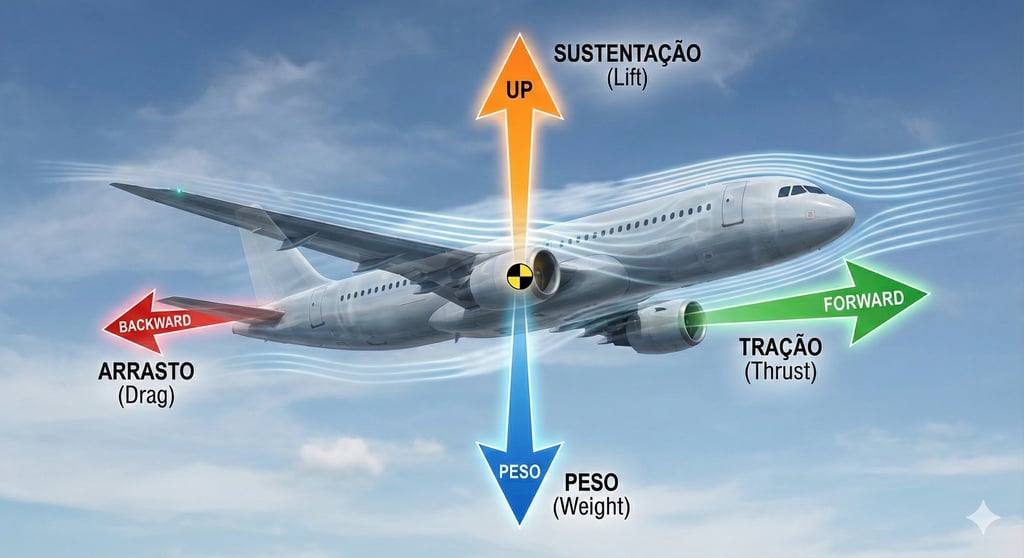
At any moment during a flight, four fundamental forces are acting upon the aircraft. The behavior of the plane—whether it climbs, descends, accelerates, or slows down—depends entirely on which of these forces is dominant at that instant.
Did you enjoy it?
Spread the word
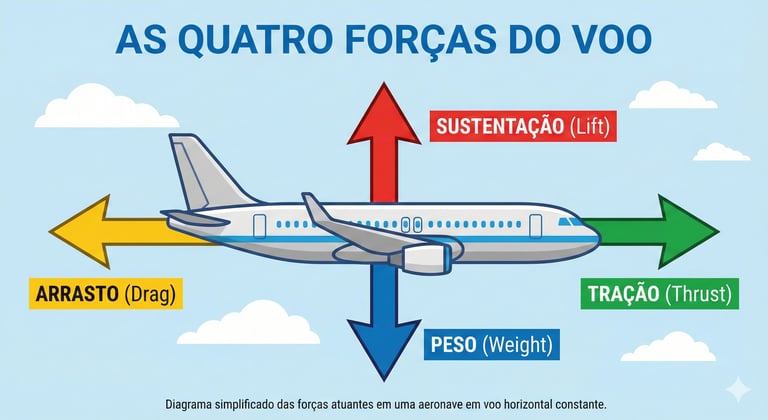
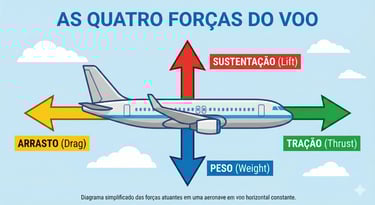
table, level flight is not the absence of these forces, but rather the perfect balance between them.
Lift: This is the force that pulls the airplane upward, opposing gravity. It is primarily generated by the wings. For the plane to climb, lift must be greater than weight.
Weight: This is the force of gravity pulling the mass of the airplane (structure, fuel, passengers, and cargo) toward the center of the Earth. Airplane design constantly struggles to keep weight as low as possible.
Thrust: This is the force that moves the airplane forward. It is generated by the engines (whether propellers or jet turbines), which push air backward violently, propelling the aircraft forward (Newton's Third Law: action and reaction).
Drag: This is air resistance. Imagine trying to run inside a swimming pool; the water resists your movement. The air does the same to the airplane. The sleek, aerodynamic design of aircraft serves to minimize this force that tries to slow the plane down.
The pilot manages these forces: they use the engine to create thrust and overcome drag, and use speed and wing shape to create lift and overcome weight.
The Secret of the Wings: Generating Lift
Thrust is easy to understand (powerful engines), and weight and drag are natural enemies. But the real "magic" happens with lift. How does a wing create an upward force?
The answer lies in the special shape of the wing, called an airfoil. If you cut a wing in half and look at it from the side, you will see it isn't flat. It is generally curved on top and flatter on the bottom. Furthermore, the wing is mounted on the plane with a slight upward tilt relative to the oncoming wind, known as the "angle of attack."
There are two main explanations for lift, and both happen simultaneously; they are different ways of describing the same physical phenomenon.
1. Pressure Difference (Bernoulli's Principle)
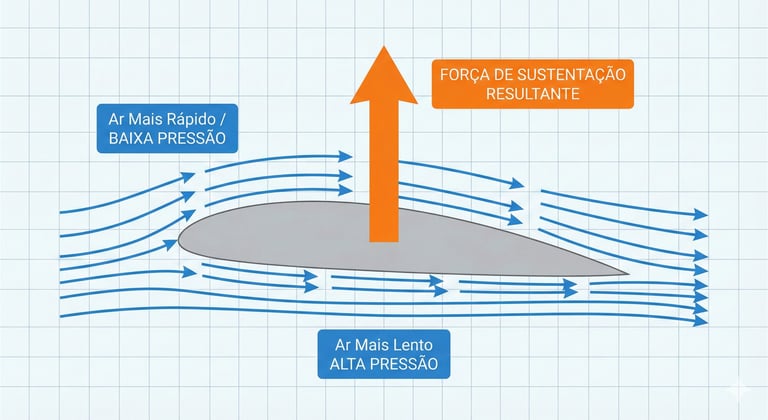
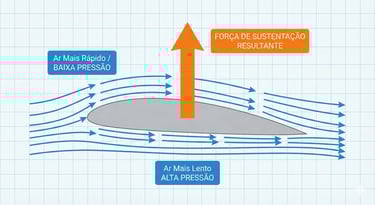
Due to the upper curvature of the wing, the air passing over the top has a "longer" path and must accelerate to get around the curve. The air passing underneath follows a straighter path and remains slower.
Bernoulli's Principle states that in a fluid (like air), when speed increases, pressure decreases. Therefore, the fast air on top of the wing creates a zone of low pressure. The slower air underneath maintains higher pressure. This pressure difference creates a resulting force that pushes the wing from the bottom up.
2. Airflow Reaction (Newton's Third Law)
This explanation is more intuitive. Remember putting your hand out of a moving car window and tilting it slightly upward? The wind hits your palm and pushes it back and up.
The same happens with the wing. Due to its angle of attack and shape, the wing "attacks" the air and deflects it downward as it passes. If the wing pushes tons of air down, Newton's Third Law (action and reaction) states that the air must push the wing up with equal force. This "downwash" of air behind the wing is crucial for lift.
Piloting the Machine: Flight Controls
An airplane doesn't just fly in a straight line. It needs to turn, climb, and descend. To do this, the pilot doesn't "turn a steering wheel" like in a car. Instead, they alter the shape of the airplane's surfaces to temporarily unbalance the four forces and change direction.
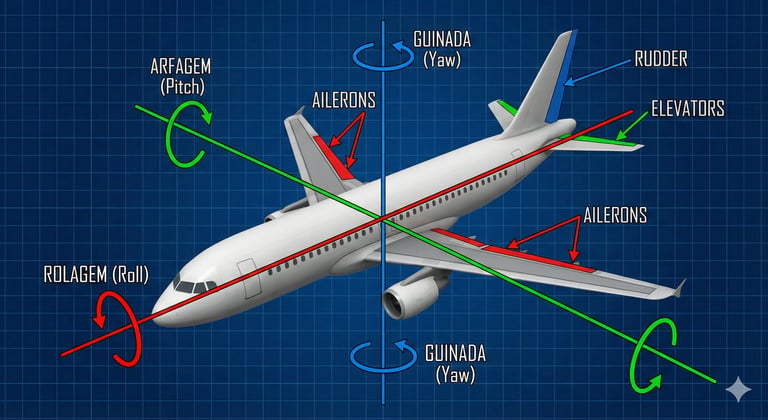
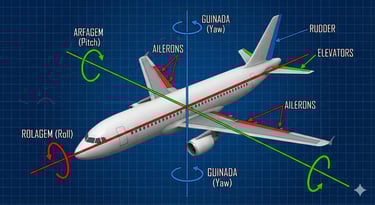
This is done through movable control surfaces on the wings and tail, which rotate the plane around three imaginary axes.
Roll – Using Ailerons: To turn left or right, the plane needs to "bank" the wings. On the trailing edges of the wings are the ailerons. If the pilot wants to turn left, the left aileron goes up (decreasing lift on that wing) and the right aileron goes down (increasing lift). The right wing lifts and the left drops, initiating the turn.
Pitch – Using Elevators: To point the nose of the plane up (climb) or down (descend), the pilot uses the elevators, located on the horizontal tail. By pulling back on the yoke, the elevators go up. The wind hits them and pushes the tail down, which forces the nose up, increasing the wings' angle of attack and making the plane gain altitude.
Yaw – Using the Rudder: To move the plane's nose left or right without banking the wings (like a boat), the pilot uses pedals to move the rudder, located on the vertical tail fin. Moving the rudder left makes the wind push the tail to the right, pointing the nose to the left. This is mainly used for fine adjustments and keeping the plane aligned with the runway during crosswind landings.
Conclusion
Human flight is one of engineering's greatest achievements. It is not a victory over nature, but rather a deep and respectful understanding of its laws. By manipulating air with precise shapes and brute force, we transform the atmosphere into a highway.
The next time you board a plane, remember that you aren't just sitting in a chair in the sky. You are at the center of a dynamic and powerful ballet of pressure, speed, and opposing forces, all perfectly orchestrated to get you to your destination safely.
Contact
Fale conosco para mais informações.
© 2025. All rights reserved.
About me