
The Invisible Threat on the Runway - FOD (Foreign Object Debris)
Understand what FOD is in aviation, the risks debris pose to aircraft, and the best prevention practices to ensure operational safety on runways and in hangars. Foreign Object Debris
BLOGRECENTES
1/24/20268 min read
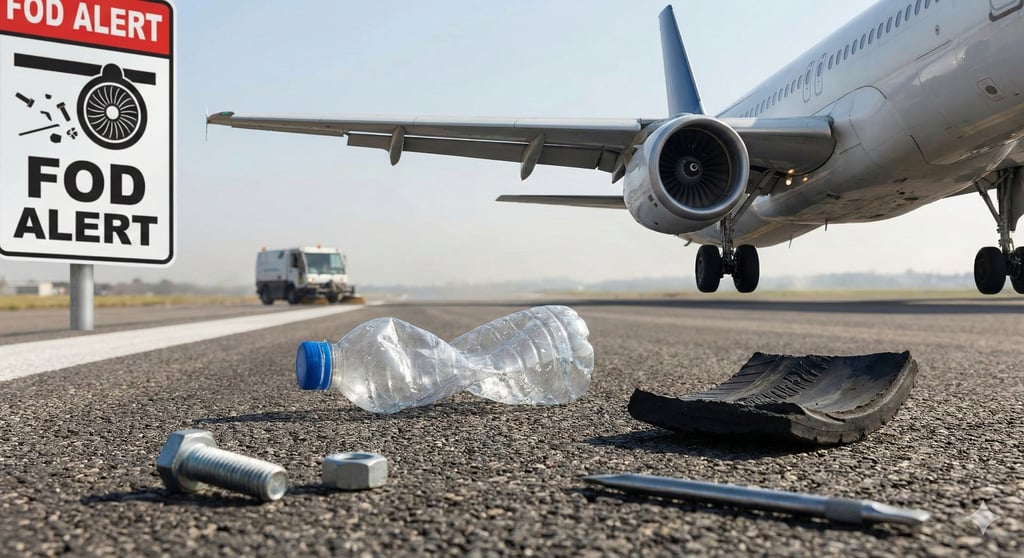
In the complex and rigorous world of aviation, safety is the fundamental pillar. Paradoxically, one of the greatest threats to flight operations does not come from complex mechanical failures or extreme weather conditions, but from something much smaller and seemingly harmless: a loose screw, a tire fragment, or a tool forgotten on the runway. These items, collectively known as Foreign Object Debris (FOD), represent a silent danger that can lead to catastrophic consequences.
In simple terms, FOD is any object that does not belong in an airport environment and has the potential to cause damage. However, the importance of this concept is so far-reaching that the acronym FOD has a triple and crucial meaning in the industry:
Foreign Object Debris: Refers to the object itself—the physical item in the wrong place.
Foreign Object Damage: Refers to the resulting damage caused by that object.
Foreign Object Detection: Refers to the systems and processes used to find these objects.
This "conceptual trinity" establishes the central theme of aviation safety: the presence of a simple piece of debris requires effective detection to prevent devastating damage. To understand the gravity of this threat, we must look at the event that became the most tragic and transformative example of the danger of FOD.
The Disaster that Changed Aviation: The Tragedy of Air France Flight 4590
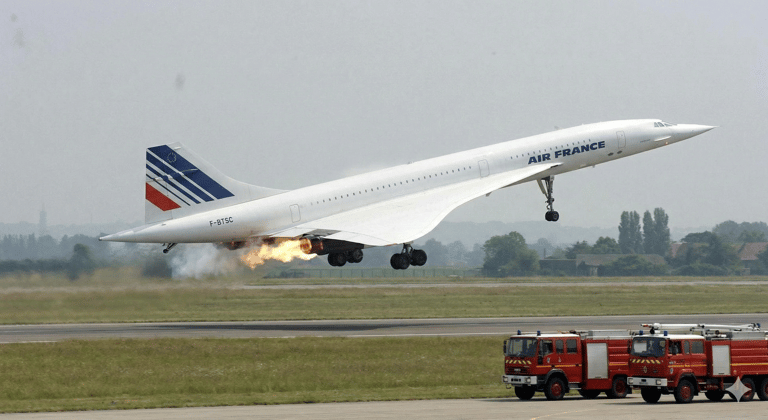
On July 25, 2000, the iconic Concorde, a symbol of supersonic engineering, was about to take off from Charles de Gaulle Airport in Paris. What was supposed to be a routine flight turned into one of the most significant disasters in aviation history, all because of a small piece of metal on the runway.
The sequence of events, now a definitive case study on FOD risks, unfolded in seconds:
The Initial Object: Minutes before the Concorde’s takeoff, a DC-10 from another airline had departed from the same runway. During its departure, a titanium strip approximately 43 centimeters long—part of the engine cowl (wear strip)—came loose and fell onto the asphalt.
The Impact: Accelerating for takeoff at over 300 km/h (186 mph), the Concorde's front left tire struck the metal strip. The extreme tire pressure, about six times that of a car, caused it to explode violently.
The Fatal Consequence: A large chunk of tire rubber, weighing 4.5 kg, was hurled against the underside of the aircraft's wing. The impact did not directly pierce the fuel tank but created a powerful hydraulic shock wave inside it. The pressure was so intense that the tank ruptured from the inside out, releasing a massive amount of fuel that ignited instantly, causing a massive fire.
The Tragic Result: With engines on fire and losing power, the crew could not control the aircraft, which crashed into a nearby hotel. The accident resulted in the death of all 113 people involved: 100 passengers and 9 crew members on board, and four people on the ground.
The main lesson learned from the Concorde tragedy was brutally clear: in aviation, FOD represents a systemic failure in the safety chain. It is not just a collective responsibility, but a demonstration of how one organization's lapse can directly create a fatal hazard for another, even if their aircraft never share the sky at the same time. This disaster forced the industry to radically re-evaluate its runway safety procedures and better understand the anatomy of this omnipresent threat.
The Anatomy of a Threat: What Really is FOD?
Following the Concorde tragedy, the definition and management of FOD became a global priority. The US Federal Aviation Administration (FAA) formally defines Foreign Object Debris as:
"Any object, live or not, located in an inappropriate location in the airport environment that has the capacity to injure airport or air carrier personnel and damage aircraft."
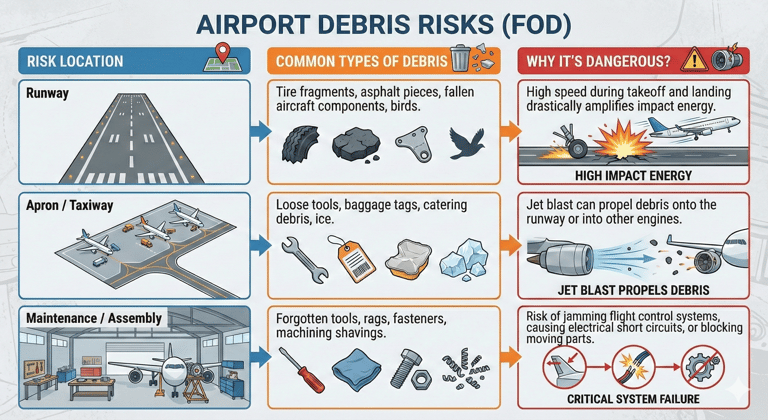
This broad definition covers a vast range of items. For effective risk analysis, FOD is classified by its origin, distinguishing between environmental threats and process failures.
External FOD Refers to objects originating from the natural environment or airport infrastructure.
Infrastructure Debris: Pieces of asphalt or concrete breaking loose from runways, taxiways, and aprons.
Nature: Rocks, sand, ice, volcanic ash, and wildlife such as birds, mammals, and even insects.
Aircraft and Vehicle Parts: Bolts, nuts, metal fragments, and tire pieces that come loose during operations.
Internal FOD Refers to objects left behind due to human error, usually during maintenance, assembly, or service processes.
Maintenance Tools and Materials: Forgotten tools, cleaning rags, safety wire, metal shavings, and fasteners.
Personal Items and Trash: ID badges, pens, baggage tags, paperwork, packaging, and catering debris.
The risk associated with each type of FOD varies drastically depending on where it is found. Understanding what constitutes FOD and where it poses the greatest risk is the first step. The next step is understanding the physics behind how such a small object can cause such massive destruction.
The Physics of Destruction: How Can Something So Small Cause So Much Damage?
The danger of FOD lies not in its size, but in the immense kinetic energy involved in aircraft operations. Engines, tires, and control systems operate in high-energy states where interaction with a foreign object can trigger a cascading failure. The three most critical damage mechanisms are:
1. Engine Ingestion Jet engines work by sucking in colossal volumes of air. When a solid object is ingested, it becomes a projectile that can initiate both metallurgical and aerodynamic failures.
Metallurgical Consequence: The initial impact creates a notch or dent on the edge of a compressor blade. Under the extreme dynamic loads of normal operation, this imperfection becomes a stress concentration point, initiating a High Cycle Fatigue (HCF) crack. If the crack propagates, the blade fractures, and its fragments destroy subsequent engine stages. This can lead to an "uncontained failure," where pieces of metal are ejected through the engine casing, potentially piercing the fuselage or fuel tanks.
Aerodynamic Consequence: A jet engine compressor operates in a delicate balance, "pushing air against an adverse pressure gradient." Damage to a blade can disrupt airflow, leading to a compressor stall, where air separates from the blade surface. This can evolve into a surge—a violent, explosive reversal of airflow exiting the front of the engine—causing severe mechanical damage and total loss of thrust.
2. Tire Explosions Aircraft tires are pieces of high-performance engineering, inflated with nitrogen to pressures reaching 200 psi (pounds per square inch)—about six times the pressure of a passenger car tire. This high pressure is necessary to support the weight and extreme speeds of the aircraft. However, it also turns the tire into a vessel of pressurized energy. A puncture caused by a sharp object on the runway can lead to an explosive failure, hurling large, heavy rubber fragments with enough force to puncture fuel tanks and cause severe structural damage, as tragically seen in the Concorde accident.
3. Jamming and Blocking Not all FOD damage is explosive or immediate. Subtler dangers can be equally fatal. Insects or maintenance debris can block critical speed sensors, such as Pitot tubes, providing erroneous information to pilots. Even more dangerous is internal FOD—a tool forgotten inside the aircraft. Documented cases show this is not an isolated occurrence:
In a fatal accident involving a Yak-52, a tool left in the cockpit jammed the flight controls, preventing the pilot from controlling the plane.
During an inspection of a Cessna 208B, a screwdriver was found jammed in the elevator cables, severely restricting control movements.
These physical damages not only put lives at risk but also impose a gigantic financial burden on the aviation industry.
The Price of Carelessness: The Billion-Dollar Cost of FOD
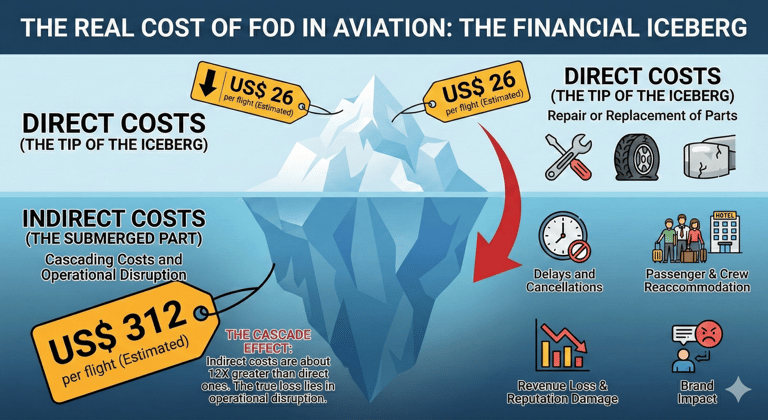
The impact of FOD goes far beyond physical repairs. It generates a cascade of operational and financial costs affecting the entire industry. Global estimates place the annual cost of FOD in a staggering range, varying from US$ 4 billion to US$ 22.7 billion.
To make this number more concrete, studies analyze the impact per flight, revealing that every takeoff carries an average cost of US$ 338 associated with FOD risk. The majority of this value does not come from repairs, but from indirect costs, which can be 10 to 12 times higher than direct costs.
To combat these existential risks and astronomical costs, the aviation industry has declared a true war on FOD, combining human vigilance with cutting-edge technology.
The War Against FOD: Prevention and Technology
Effective FOD mitigation depends on an integrated system combining human responsibility with advanced technological tools. The strategy is multifaceted, focusing on prevention, detection, and rapid removal.
1. The Human Factor and Safety Culture The foundation of any successful FOD prevention program is the culture that safety is everyone's responsibility. To manage human risk systematically, facilities are divided into FOD Prevention Areas (FPAs) with increasing levels of rigor:
FOD Awareness Area: Low-risk zones, such as offices or distant storage areas, where the focus is on general cleanliness and basic awareness.
FOD Control Area: Medium-risk zones, such as aprons and hangars, requiring strict control over tools, hardware, and personal items, with inventories before and after tasks.
FOD Critical Area: Very high-risk zones, such as the interior of engines or open flight system compartments. Here, control is total: restricted access, tethered tools, a ban on personal items, and mandatory inspections before closing panels.
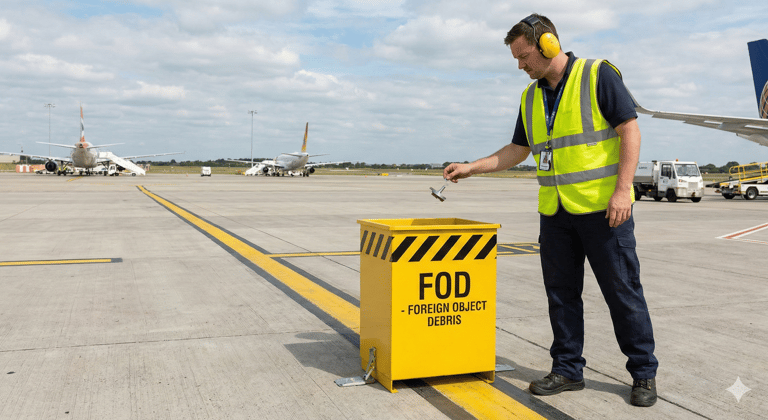
This layered approach is sustained by the fundamental philosophy of "Clean As You Go" and regular physical inspections, such as "FOD Walks," where teams line up to walk runways and aprons to manually collect debris.
2. Technology to the Rescue While human vigilance is irreplaceable, technology offers continuous, large-scale monitoring.
Removal Equipment: Specialized tools such as friction sweepers (e.g., FOD-Razor), vacuum sweepers, and large magnetic bars attached to vehicles are used to collect debris quickly and efficiently.
Automated Detection Systems: The forefront of the fight against FOD involves sensor fusion, combining different technologies to monitor runways 24/7. Millimeter-wave radars detect objects in any weather condition but lack visual detail. High-resolution cameras (EO/IR) provide visual confirmation and color but are limited by visibility. By fusing the data, the system overcomes the weaknesses of each sensor. Artificial Intelligence (AI) analyzes this information to distinguish real threats from false alarms—for example, a screw versus a leaf—allowing teams to respond only to real dangers almost instantly.
The combination of well-trained professionals and cutting-edge technology creates a powerful safety culture, transforming FOD prevention from a reactive task into a proactive and vigilant strategy.
Conclusion: A Culture of Vigilance for Safer Skies
The history of Foreign Object Debris in aviation is a powerful reminder that, in complex systems, the smallest details matter immensely. FOD is not just a cleanliness issue; it is a multifaceted threat with devastating consequences for safety and the economy. The Concorde disaster serves as a permanent milestone, teaching the industry that prevention is infinitely more valuable than correction.
Modern aviation safety is not achieved by chance. It is the result of a culture of meticulous vigilance, where rigorous attention to detail on the ground ultimately ensures safety in the air. Through the combined effort of dedicated professionals practicing daily vigilance and innovative technology monitoring tirelessly, the fight against FOD continues to make air travel one of the safest forms of transport in the world for all of us.
Did you enjoy it?
Spread the word
Contact
Fale conosco para mais informações.
© 2025. All rights reserved.
About me