
The Passenger’s Nightmare: What Really Happens If an Engine Fails Mid-Flight?
Spoiler: The plane doesn't drop like a rock. Understand the engineering and procedures that keep you safe even in the worst-case scenario.
BLOGTRIVIARECENTES
12/26/20252 min read
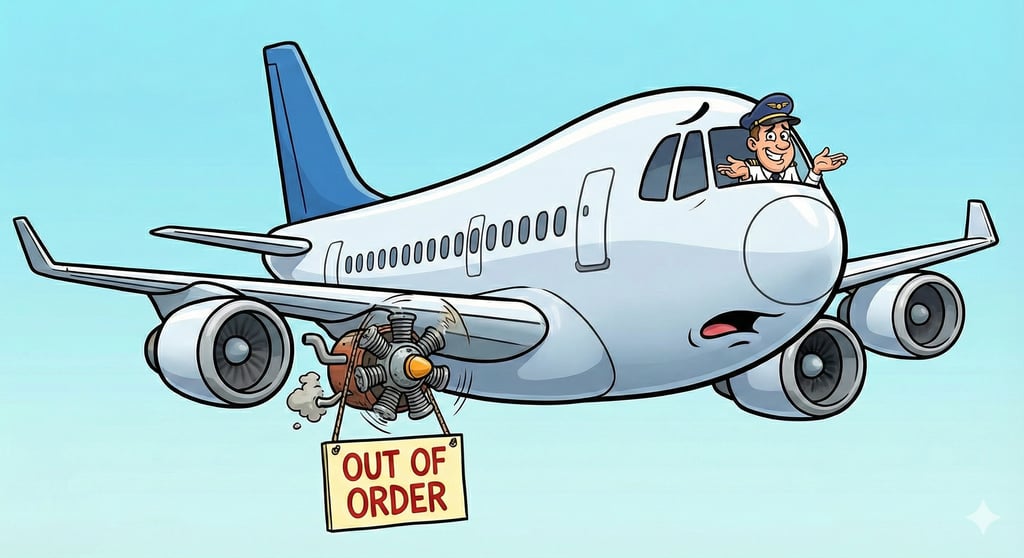
It’s a classic movie scene: a strange noise, a turbine grinding to a halt, and panic spreading through the cabin. But in real life, what actually happens when one of the engines on a commercial jet decides to "call it quits" at 38,000 feet?
If you’ve ever broken into a cold sweat thinking about this, I have good news: modern aviation was designed entirely for this exact moment.
1. The Myth of Free Fall
The first thing you need to know is that planes don’t need engines to fly; they need engines to maintain altitude and speed. Without them, the aircraft becomes a giant, highly efficient glider.
But the reality in commercial aviation (Boeing, Airbus, Embraer) is even calmer: they are twin-engine aircraft (twinjets). And twinjets are certified to take off, fly, and land with only one engine.
2. The Physics: The "Drift Down"
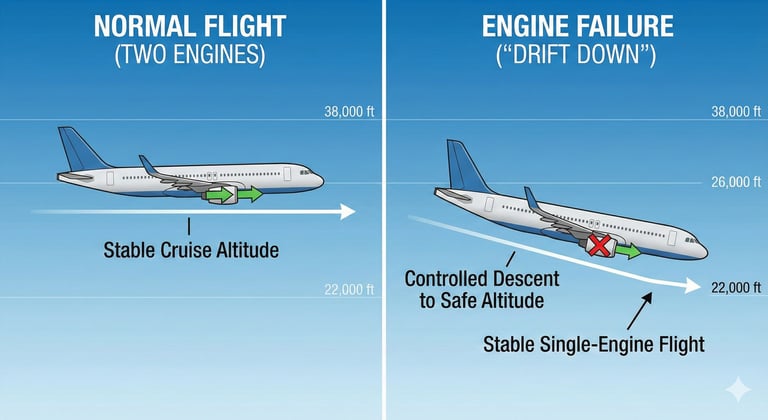
When an engine fails at cruising altitude, the plane loses 50% of its power, but not 50% of its flying ability. What happens is a procedure called "Drift Down" (controlled descent).
What the pilot feels: The plane tends to turn (yaw) toward the side of the stopped engine (since the working engine is still pushing). The pilot (or the autopilot) compensates for this using the rudder on the tail.
What the plane does: With only one engine, it cannot maintain its maximum altitude (e.g., 40,000 ft). It will descend smoothly to a safe altitude (usually between 20,000 and 25,000 ft), where the air is denser and the remaining engine can sustain flight on its own.
3. The Golden Rule: ETOPS
Have you ever seen the acronym ETOPS? In English, there's a joke that it stands for "Engines Turn or Passengers Swim," but the technical term is serious: Extended-range Twin-engine Operations.
This rule dictates how far a twin-engine plane can fly from an airport.
In the old days, planes had to stay close to runways.
Today, technology is so reliable that a Boeing 777 or 787 can fly for more than 5 hours on just one engine over the ocean until it finds a place to land.
4. The Movie Scenario: What if THEY ALL stop?
It is extremely rare (like the famous "Miracle on the Hudson"), but if it happens, physics still helps. A commercial jet has a glide ratio of about 15:1 or more.
This means that for every 1 km of altitude lost, it moves 15 km forward.
If the engines stop at 10 km (33,000 ft) high, the pilot has a distance of about 150 km to choose where to land. That is enough time to try to restart the engines or plan an emergency landing.
5. What Happens in the Cockpit?
While passengers might be tense, the atmosphere in the cockpit is one of "problem-solving," not panic. Training follows the mantra: Aviate, Navigate, Communicate.
Aviate: Stabilize the airplane with the remaining engine.
Navigate: Decide where to go (turn back, continue, or divert).
Communicate: Notify air traffic control ("Mayday" or "Pan-Pan") to get absolute priority for landing.
Conclusion
Is losing an engine an emergency? Yes. Is it fatal? Almost never. The next time you hear the sound of the engines change during a flight, relax. It’s probably just the pilot adjusting power to save fuel. But even if the silence comes from one side, engineering guarantees you’ll reach the ground safely.
Did you enjoy it?
Spread the word
Contact
Fale conosco para mais informações.
© 2025. All rights reserved.
About me