
Understanding IATA and ICAO Airport Codes
Do you know why airport codes have three letters? Understand the difference between IATA and ICAO codes, how they originated, and why they are essential for global aviation
TRIVIABLOGRECENTES
12/23/20252 min read
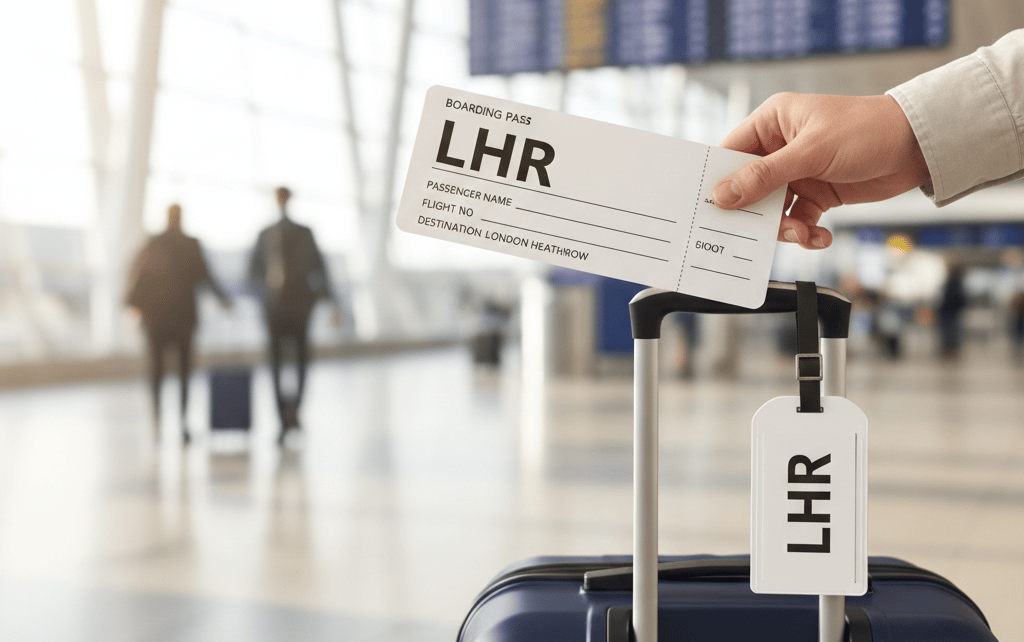
If you’ve ever looked at your boarding pass and wondered why Rio de Janeiro is GIG or why London appears as LHR, you’ve encountered airport codes. They are the "fingerprints" of every terminal in the world.
While they may seem like random strings of letters, these codes are the pillars of global aviation organization. What most passengers don’t know is that there are actually two different systems operating simultaneously: IATA and ICAO.
The Traveler’s Alphabet: The IATA Code
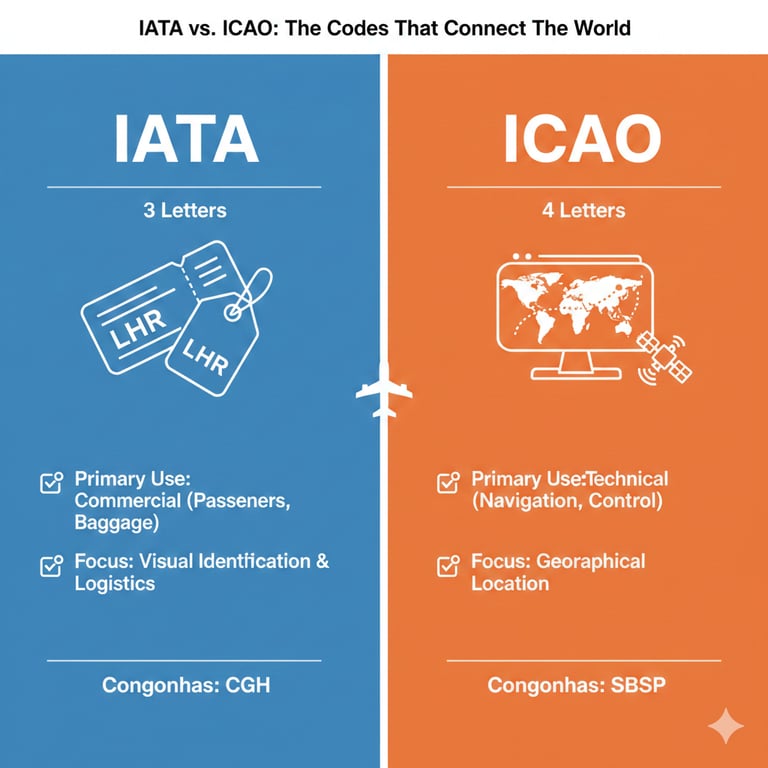
The IATA (International Air Transport Association) code is what you see in your daily life. These are the three-letter identifiers that appear on luggage tags, departure boards, and booking websites.
How Did They Originate?
In the early days of aviation in the 1930s, pilots used the two-letter identification from local weather services to identify their location. As the number of airports grew, the combinations ran out. In 1947, the three-letter system was standardized, allowing for 17,576 possible combinations.
Fun Facts about their Formation:
The "X" Rule: Many old airports used only two letters. When the system shifted to three, they simply added an "X". This is why Los Angeles is LAX and Dubai is DXB.
The Canadian "Y": Almost all major airports in Canada start with the letter Y (like YYZ for Toronto), a legacy from old radio transmitter codes.
Technical Precision: The ICAO Code
While you are looking at the IATA code, pilots and air traffic controllers are looking at the ICAO (International Civil Aviation Organization) code. This code consists of four letters and is used for technical purposes: flight plans, air traffic control, and satellite communications.
Unlike IATA, which is often mnemonic (linked to the city or airport name), ICAO is geographical.
How Does It Work?
The first letter indicates the region of the world, and the second indicates the country.
In Brazil, all ICAO codes begin with S (South America) and B (Brazil).
Guarulhos Airport, whose IATA is GRU, has the ICAO code SBGR.
London Heathrow (LHR) is technically identified as EGLL (E for Northern Europe, G for Great Britain).
Comparison: IATA vs. ICAO
Did you enjoy it?
Spread the word
What are they for, anyway?
Imagine the chaos if a reservation system had to process "São Paulo/Guarulhos – Governador André Franco Montoro International Airport" every time someone bought a ticket.
Codes eliminate language barriers and the risk of ambiguity. They ensure your suitcase is sent to SYD (Sydney, Australia) and not SID (Sal Island, Cape Verde). They are the universal language that allows thousands of flights to take off and land every day with surgical precision.
Next time you hold your ticket, look at those three letters. They aren't just an abbreviation; they are the final destination of a complex web of engineering and history that connects the entire world.
Contact
Fale conosco para mais informações.
© 2025. All rights reserved.
About me