
UTC: The "Master Clock" That Synchronizes the World
The 3 Letters That Prevent the Internet (and Aviation) From Collapsing.What is UTC and why did it replace GMT? Discover how Coordinated Universal Time synchronizes the internet, aviation, and the modern world in this complete guide.
BLOGTRIVIARECENTES
12/27/20253 min read
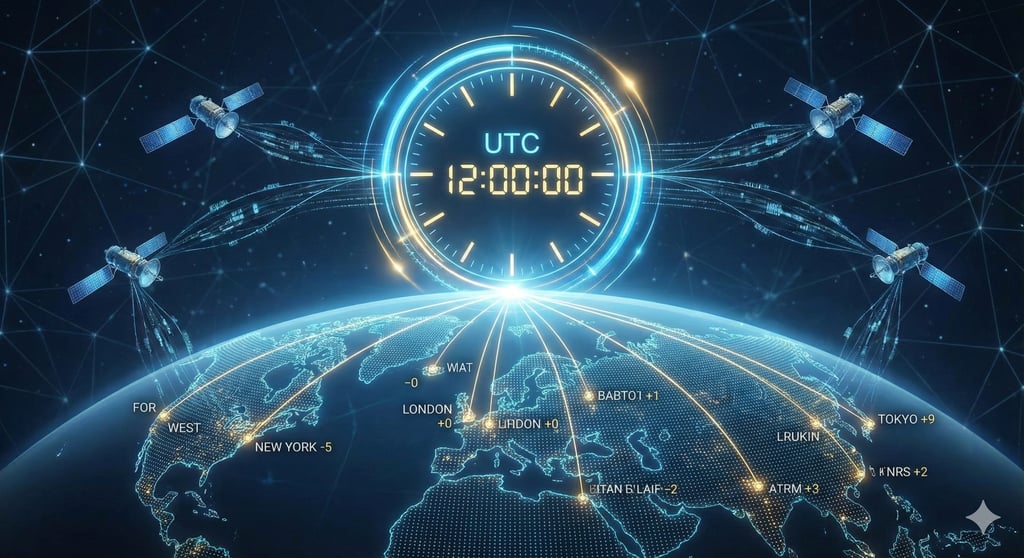

Have you ever stopped to wonder how the internet, airplanes, and the global banking system manage to function in perfect harmony, even though they are spread across dozens of different countries? The answer isn’t magic; it’s science. The secret is a three-letter acronym: UTC.
Often confused with GMT, UTC is the backbone of modern timekeeping. But how did it come about, and why did we abandon the old methods? In this article, we’ll dive into the history and utility of this universal measurement.
What Is UTC?
UTC stands for Coordinated Universal Time.
Contrary to what many people think, UTC is not exactly a physical "time zone," but rather a time standard. It is the reference point from which all other time zones on the planet are calculated.
For example, when we say that a specific time zone is "UTC-3," we are saying that location is three hours "behind" the global master clock.
The Origin: Why Wasn't GMT Enough?
To understand UTC, we need to look at its predecessor: GMT (Greenwich Mean Time).
Since 1884, the world used the Royal Observatory in Greenwich, London, as the zero point for time. GMT was based on the Earth's rotation and the position of the Sun. It worked well for decades for ships and trains.
However, in the mid-20th century, scientists discovered a problem: Earth is not a perfect clock.
Our planet's rotation is slightly irregular.
It slows down minimally due to tides and the Moon's gravity.
Geological events (like massive earthquakes) can alter rotation speed.
With the advent of modern technology (satellites, GPS, computers), we needed nanosecond precision. GMT, based on the Earth's imperfect rotation, became obsolete for cutting-edge science.
The Atomic Revolution
The solution was to stop looking at the sky and start looking at atoms. In the 1960s, the world began adopting International Atomic Time (TAI), calculated by a network of cesium atomic clocks, which are incredibly precise and don't lose even a second in millions of years.
UTC was officially born in 1960 (formalized with that name a few years later) as a hybrid:
It uses the super-precision of atomic clocks.
But it makes occasional adjustments to remain synchronized with the Earth's rotation (so that noon remains when the Sun is overhead).
Fun Fact: The acronym UTC was a diplomatic compromise. English speakers wanted CUT (Coordinated Universal Time) and French speakers wanted TUC (Temps Universel Coordonné). To avoid favoring either language, UTC was adopted.
What Is UTC Used For Today?
You use UTC every day, even without knowing it. It is essential for keeping global civilization connected.
1. Aviation and Navigation
Pilots and air traffic controllers cannot afford to confuse local times. If a plane leaves New York for Tokyo, all flight plans, communications, and radars operate in UTC (often called "Zulu Time" in aviation). This prevents catastrophic accidents due to calculation errors.
2. Internet and Technology
Your emails, server logs, and banking transactions need an exact chronological order.
When you send a message on WhatsApp, the server records it in UTC.
Your computer converts that time to your local time zone only to display it on the screen for you.
3. GPS and Geolocation
The GPS system in your car or phone relies on satellites that send ultra-precise time signals. A one-millisecond error in the satellite's clock would result in a position error of hundreds of kilometers on Earth. UTC guarantees this precision.
4. Science and Astronomy
To track stars, predict eclipses, or coordinate rocket launches, astronomers use UTC to ensure that telescopes around the world are pointing at the same place at the exact same instant.
The End of the "Leap Second"?
Because UTC (atomic) is perfect and Earth (rotation) is slowing down, UTC sometimes drifts away from solar reality. To correct this, scientists occasionally insert a "leap second." It is an extra second added to the last minute of the year.
However, this causes headaches for tech companies (like Google and Facebook), because computers hate irregularities. Recently, the scientific community voted to abolish the leap second by 2035, allowing UTC to deviate slightly from solar time in favor of perfect continuity for technology.
Conclusion
UTC is the "heartbeat" of the modern world. It was created to solve the inaccuracy of Earth's rotation and meet the demands of the digital age. Without it, the internet would be chaotic, GPS wouldn't work, and air travel would be much more dangerous.
The next time you look at the clock on your smartphone, remember: it is silently conversing with an atomic clock somewhere, ensuring you are synchronized with the rest of the planet.
Did you enjoy it?
Spread the word
Contact
Fale conosco para mais informações.
© 2025. All rights reserved.
About me