Why do airplane bathrooms have ashtrays?
Discover why airplane bathrooms still have ashtrays, even after smoking was banned. Learn the history and curiosities behind this unusual practice on flights.
BLOGTRIVIARECENTES
12/27/20255 min read
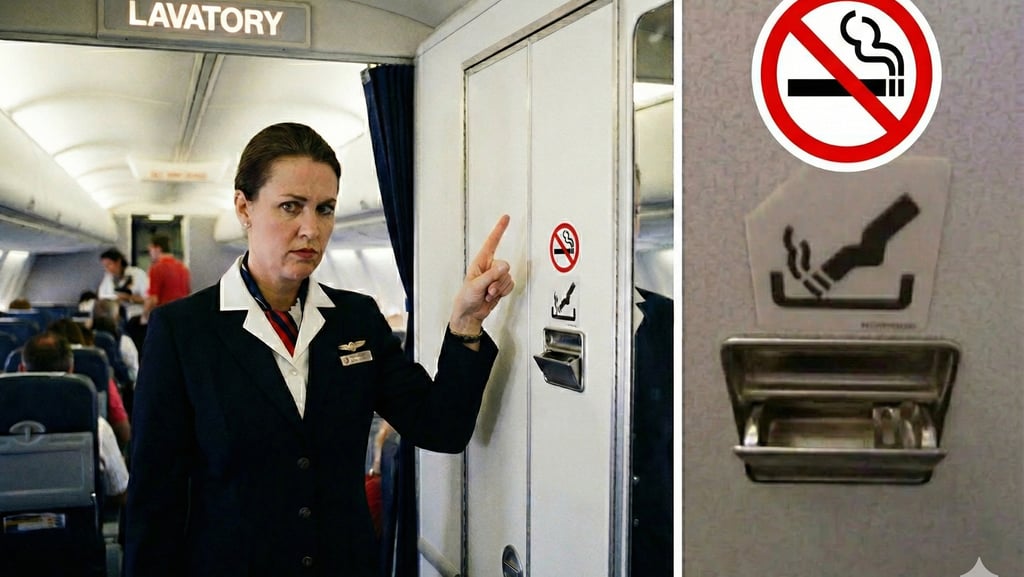
If you’ve flown recently and paid attention to the details in the lavatory, you’ve likely stumbled upon a design contradiction that seems to defy logic. Right there, on the door or next to the sink—often just inches away from a lit "NO SMOKING" sign and a sensitive smoke detector—is a small metal square with a flip cover: an ashtray.
To the modern traveler, this looks like a mistake. A relic of a forgotten era, akin to finding a cassette tape deck in a Tesla. After all, smoking on commercial flights was progressively banned starting in the late 80s and has been universally prohibited for over two decades.
So, why do ultra-modern aircraft manufacturers like Boeing and Airbus continue to install ashtrays on jets fresh off the assembly line? The answer isn’t design laziness, nor is it nostalgia. It is a fascinating (and somewhat grim) lesson on human nature, safety engineering, and catastrophic risk management.
The Era of Smoke: A Brief Context
To understand the presence of the ashtray, we must first look to the past. There was a time when aviation was synonymous with glamour, porcelain meal service, and, of course, clouds of cigarette smoke. Until the mid-80s, smoking onboard wasn’t just allowed; it was expected. Planes were divided into smoking and non-smoking sections (though, as we know, smoke doesn't respect fabric curtains).
The transition to a total ban was slow. It began with short domestic flights in the US, expanded to international routes, and finally became a global rule driven by ICAO (International Civil Aviation Organization). Today, the idea of lighting a cigarette in a pressurized tube at 30,000 feet seems insane, but aviation infrastructure was built on this premise for decades.
However, legal prohibition did not eliminate human addiction. And this is where safety engineering must intervene.
The Tragedy That Changed Everything: Varig Flight 820
Aviation is an industry where safety rules are, unfortunately, "written in blood." Almost every safety procedure we follow today is the result of previous accidents. Regarding ashtrays and the danger of fire onboard, one of the saddest chapters involves a Brazilian airline.
On July 11, 1973, Varig Flight 820, a Boeing 707 flying from Rio de Janeiro to Paris, was preparing to land at Orly Airport. Just minutes from the destination, a fire started in the rear lavatory. The probable cause? A lit cigarette thrown into the paper towel wastebin.
The fire spread with terrifying speed—not through visible flames, but through toxic, dense smoke that invaded the cabin. The pilot was forced to make an emergency landing in an onion field. Although the landing was technically successful, the smoke killed most of the occupants via asphyxiation before the aircraft even touched the ground. Of the 134 people on board, 123 died.
This accident (along with others, such as Air Canada Flight 797 in 1983) forever changed how the industry views fire onboard. It was discovered that wastebins full of paper are perfect fuel sources and that late detection is fatal.
The Logic of the "Lesser Evil"
Here we enter the pragmatic reason for the existence of modern ashtrays. The premise of regulatory agencies, such as the FAA (in the US), EASA (in Europe), and ANAC (in Brazil), is based on a realistic principle of human psychology: prohibition does not prevent 100% of infractions.
Authorities know that, statistically, on some flight somewhere in the world, a passenger addicted to nicotine—desperate or simply rebellious—will decide to break the law and smoke in the bathroom. They know that heavy fines and threats of jail time are not enough to stop the physical compulsion of every single passenger.
If this passenger lights a cigarette in secret, they will need to extinguish it quickly if they hear someone approaching or get spooked. If there is no safe place to discard the butt:
They might flush it down the toilet (where the vacuum suction system could cause issues, though minor);
Or, in the worst-case scenario, they will throw it in the paper wastebin to hide the evidence.
If the cigarette butt is still glowing and comes into contact with dry paper towels, the result could be an uncontrollable onboard fire in a matter of minutes.
Therefore, the bathroom ashtray is not an invitation to smoke. It is a piece of emergency safety equipment. It exists to ensure that if someone breaks the law, they don't also break the aircraft and kill everyone on board. It is the materialization of "harm reduction."
What Does the Law Say?
The requirement is so serious that it is listed in the FAA's Code of Federal Regulations (Title 14 CFR 25.853). The rule stipulates that ashtrays must be installed on or near the lavatory doors.
Even more curious is that the ashtray is considered a "No-Go" item on many Minimum Equipment Lists (MEL). This means that, technically, if a plane is about to take off and the crew realizes the bathroom ashtray is broken or missing, the plane cannot take off until the item is replaced or that specific bathroom is sealed off and locked from use.
Imagine the cost to an airline of delaying a flight because a ten-dollar piece of metal is missing. This demonstrates that, for aeronautical engineering, fire prevention trumps any "common sense" logic that no one should be smoking there in the first place.
Fail-Safe Design
The presence of the ashtray is a brilliant example of Fail-Safe Design. Engineers do not design the world for how it should be (a place where everyone follows the rules), but for how it really is (a place where people make mistakes, are reckless, or disobedient).
beyond the ashtray, modern lavatories have other layers of protection against the "cigarette factor":
Smoke Detectors: Extremely sensitive and difficult to bypass.
Automatic Extinguishers: Located inside the wastebin (under the sink). If the heat in the bin rises (indicating fire), the extinguisher discharges automatically, sealing the location with a chemical agent without the need for human action.
The Price of Disobedience
While the plane provides a safe way to extinguish the cigarette, this does not exempt the offender. Using the ashtray might prevent a tragedy, but it won't prevent the Federal Police upon landing.
Smoking on board is a federal crime in most countries. Consequences include:
Fines that can exceed thousands of dollars.
Immediate arrest upon landing.
Permanent banning from the airline.
If the passenger attempts to tamper with the smoke detector, the penalty is even more severe, as it is considered an attack on flight safety.
Conclusion
The next time you walk into an airplane bathroom and see that small silver ashtray, don't view it as a mistake or an incentive. See it as a silent monument to safety. It is there because history has taught us that ignoring human fallibility is dangerous.
The ashtray is aviation's way of saying: "We know you shouldn't do this, the law says you can't do this, but if you are reckless enough to do it anyway, we prefer that you and the other 200 passengers arrive at the destination alive."
It is a strange paradox, but in the world of aviation, safety always has the final word—even if that word needs to be spoken through an empty ashtray.
Did you enjoy it?
Spread the word
Contact
Fale conosco para mais informações.
© 2025. All rights reserved.
About me